
Elizabeth McCracken, The Hero of this Book and A Long Game: Notes on Writing Fiction (plus Marriage to the Sea preorders and my upcoming events)
/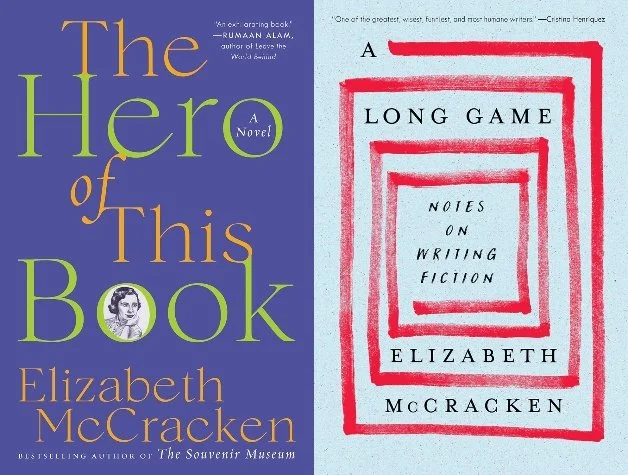
It somehow feels very like Elizabeth McCracken to write a craft/process book about writing that began as the footnotes of an earlier draft of another book. And then very like her to write about this in the craft book itself—an aphoristic, zestful, and darkly happy trip through her writing/teaching life, full of excellent, grandly amusing advice. Won over by the mixture of jokes, wisdom, and good sense, readers are likely to become partners in her defiance of the whole idea of a craft book. McCracken is a wonderful teacher—when I was a baby writer, she was my workshop leader for one splendid week at the Napa Valley Writers’ Conference. She was kind and funny and made us feel like real writers. Very necessary, because, like so many writers trying to figure out what stories we wanted to tell and how, we doubted ourselves constantly, even as we piled up draft after draft of fortunately unpublished novels (some of the best luck of a writing life is in what we don’t get published). She also demonstrated to us the best way to use wipes to remove stains from clothes, dazzling us with her aplomb and lack of embarrassment about living as (in) a body in public. A constant theme of her writing and teaching: reminding everyone to create characters who live in the world in their bodies, to capture that experience.
Here is one of her dozens of notes (chapters?) in which she describes how the craft book began:
162 For instance, until the final draft, my last novel had an auxiliary narrative in the form of a writing manual, a running commentary on the novel proper. I kept tinkering with placement, footnotes or endnotes or marginalia. (Such notes are a structure; they change the shape of narrative.) The book was by far the most autobiographical fiction I’d ever written; I had to fool myself into doing it. In the ersatz manual, I critiqued and disparaged and undermined my fiction. Oh, I was clever, I thought, sincere in my soul (the narrative) and snarky in my exoskeleton (the notes).
In the end, it didn’t work. The snarkiness of the voice was abrasive and had no through line. About 10 percent of the notes—maybe—I folded into the novel. I retained a single footnote and realized it was the reason I had wanted footnotes at all. Can a book have a single footnote? you might wonder, and my answer is, This book has a single footnote. (That’s my answer to nearly any question about fiction that starts Can a book . . . ?: This one does. Similarly in fiction classes I’m baffled when somebody says, “I don’t believe this character would do this.” It betrays a curious lack of imagination in a writer. What do you mean you don’t believe the character would do such a thing? The character just did.)
Some structures turn out to be scaffolding, indispensable in construction, extraneous at the end. You take it away to find a complete edifice with an internal structure—loadbearing walls, vaulted ceilings—that allows the novel or story to stand alone. Sometimes structure is a trellis upon which you have trained roses, and cannot be removed without collapse.
My footnotes were scaffolding, or perhaps a series of jacks that held the earlier drafts up. There is no way I could have written the book without them. With them in place, I fooled myself into writing an autobiographical novel, and, simultaneously or consecutively, the craft book you have before you.
It gives away everything, and also nothing. It’s hilarious to think of her in workshop defending improbable or illogical character actions by standing up for this imaginary person. A moment when those of us who are more like auto mechanics poking around under the hood of a car might instead start talking about how you could lay the groundwork for what initially seems improbable, or how to study examples of beloved writers successfully pulling off character contradictions.
A Long Game is a dragon cavern, heaped with treasures of memory, instruction, opinion, craft notes, and a constant, encouraging refusal to suggest simple solutions. (The quirky, entertaining index may help with finding ideas or anecdotes we want to go back to, but probably flipping through the pages looking for a particular gold candelabra or sack of emeralds is at least as helpful.) This is not a book full of specific examples or systemic precepts: it’s a wonder cabinet, a book of delights. Reading it, I felt a burst of exhilaration at the good fortune of writing, reading, and being alive in this completely weird world. Though in this two-writer household, there is more than one bookcase of books about writing, I plan to return to A Long Game often.
It sent me back to the book for which this was “scaffolding.” The Hero of this Book, which Elizabeth McCracken calls her most autobiographical book, is an astonishing portrait of a challenging mother-daughter relationship. I recommend it often for people trying to write about such relationships without falling into bitterness, demonization, or sentimentalization of the mother. It’s a book about grief that’s full of delights: McCracken’s narrator travels to London after the death of her mother, after she’s done what she can with her house and turned it over to professionals. Then she goes to museums, remembers her mother, remembers a trip they took together, wraps up so much pain in the best aphorisms, and makes the reader laugh while also breaking our hearts. It’s presented as a novel and also acknowledged as a memoir where she can take liberties. In it, she keeps only one small, plain footnote. I won’t spoil what that is—I began weeping when I read it, but you may have a very different reaction.
Until the first time I read it, I did not know that she, like me, had a mother whose relationship to accumulating stuff went beyond eccentric and into the realm of possibly dangerous. She doesn’t use the word “hoarding,” but in her complicated, specific, loving portrait of her mother, she also gives us a look at that stuff in a long passage that’s an accumulation of words, images, horror show fears, jokes, memories, wishful thinking, and then the reality that emerged:
Once I moved away, I disowned the house; I worried about it. The place was a firetrap, crammed with stacks of paper, with Jazz Age wiring and addlepated appliances. I tried not to think about it, but I failed. The house might catch fire and burn to the ground. The fire might sweep through the neighborhood. Some municipal official in my hometown (though I never thought of that suburb as my hometown) might call to blame me. The head of the Board of Health. (“If I don’t bathe, I’m going to be condemned by the Board of Health,” my mother sometimes said.) Maybe the mayor would call me up. When I was a kid, the mayor was an exuberant man who, like my mother, was Jewish and dusky, who favored pale suits, and even now when I hear of a generic mayor it’s him that I see. Kid, he’d say. How could you have let this happen? How could you have allowed your elderly parents to live in this shithole?
What choice did I have? I couldn’t have them arrested. Also, when I moved out, they weren’t elderly. Then they were.
My mother liked the story of the Collyer brothers, eccentric New York millionaires who collected books and paper and detritus. The way she told the story, one was killed when a pile of books fell over and crushed him; his brother, an invalid, then starved to death. She invoked the Collyer brothers when she thought my father should get rid of some books or maybe find shelves for them.
Fire, book collapse, flood. At any moment a disaster could befall my parents. Or, worse, nothing definitive would happen, and I would have to make an assessment and a decision: No, you cannot live here another day. I don’t know where you’ll go, but this place will kill you, the house has given you that cough, the house is the reason the wound on your leg won’t heal—wait, you have a wound on your leg that won’t heal, too? The house doesn’t love you; the house wants you dead. I love you and want you alive. Easier to blame the house than my parents, who had let it lapse into this state. Monstrous house: It had eaten my parents and was digesting them.
When I was a grown-up but still young, I imagined that my parents would eventually face facts and move to a nice apartment in the Back Bay, near their jobs at BU. Maybe they’d give up their car and take cabs. A doorman building, with an elevator. Fresh walls for the art. A spare room with a sofa bed and shelves for books. They already had a sofa bed, purchased from Castro Convertibles, upholstered in a fabric called Herculon. They had the books and the art. All they needed was to get rid of a few things. I thought they might do it.
Weekends they drove to Maine and Western Massachusetts and bought antiques: entire encyclopedias, oak rocking chairs. Their own parents died, and household goods moved in like a series of avalanches. Stuff got crammed in till leaving seemed impossible. Some cousins only a little older sold their house and moved into an assisted-living complex. My mother was embarrassed for them.
For a long time my parents got rid of nothing. The rooms filled with objects and garbage, luggage and inherited love letters, cats. In my childhood there had been a lot of animals—four cats and two dogs at the height—but in my parents’ older age it was only ever cats and only ever two. My mother’s favorite cats were male and nervous and needed her. “Come to Mommy,” my mother would say to one of them. “Yes, I love you, too.”
“You are not that cat’s mother,” I said, sitting on the sofa during a visit.
“Don’t listen to her,” said my mother.
The Collyer brothers feel like expected, necessary guests, but where did that complicated, unsettling mayor come from? And then there’s a single moment that sums up the helplessness of trying to look after family: “What choice did I have? I couldn’t have them arrested. Also, when I moved out, they weren’t elderly. Then they were.” Easier to blame the monstrous house than the parents, and for what? That mixture of an OCD ability to concentrate with a wild enthusiasm for the possibilities of stuff that some a psychiatrist who treats someone dear to me calls the essence of what we think of as hoarding disorder?
Everything is in this passage, from the fantasy of what one might wish to say, to the reality of where it all came from, to the vanished hopefulness that it could all go back (forward?) to normal. Whatever that is. And then a little vaudeville routine of mother, daughter, and cat (Elizabeth McCracken loves vaudeville, and we can see where she got that love). In fact, the passage continues from here, and it weaves in and around other passages of the book, piling up treasures as she does in A Long Game.
Here’s one more example from that book, where she both shares and defys writing advice, taking on the role of oracle while also undercutting it:
56 Years ago I heard a student ask a writer, “How do you know when you’ve chosen the right scene to write?” What a good question, I thought. (When some writers say, What a good question, they mean, I have thought a lot about this very topic myself. I mean, I have no idea; I wonder, too.) The writer answered, “I figure it’s like life. You make a decision and you stick with it. You go forward.” As both life and writing advice, this astonished me, an inveterate ditherer. Who would I be without my regrets? What am I supposed to do with my hands if not wring them? I’ve grown to understand this answer, at least as writing advice. It’s more important to choose an interesting event in fiction than a meaningful one; that is, it’s easier to make something interesting and strange meaningful than it is to take a feeling of abstract import and try to guess what event might illustrate that in an interesting way. Moreover, as a writer, in fiction you might as well run counter to your own human habits. You might as well be decisive if given to dithering. Might as well be ruthless if you’re milquetoast, or tender and expressive if you’re repressed. All-knowing when in real life people stymie you; benevolent; unafraid of parties and confrontation. At the very least, it’s good practice for the rest of your life.
Both these books give me a vision of how one might be completely oneself and also better. At the very least, it’s good practice for the rest of our lives.
Marriage to the Sea
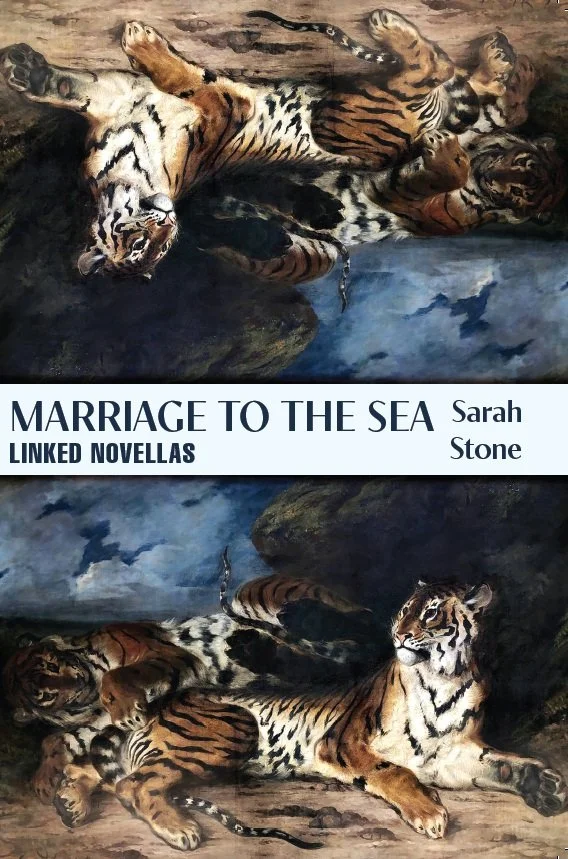
For those just joining us (hi and welcome!), what comes next is much more than I usually write about my own work and news. But my linked novellas, Marriage to the Sea—full of family bonds and misbehavior, unexpected love stories, ghosts, sustainability activists, and experimental theater people performing the sins and virtues at the Venice Biennale—comes out in two and a half weeks(!)
This is my favorite book I’ve ever written, and Four Way Books has been fabulous with editing, copyediting, proofing (many rounds!), and book production, including the beautiful cover. I’m excited to share it!
In fact, though the pub date is March 15, books preordered through FWB’s distributor are shipping now, people are already getting to know my characters, which is always both exciting and nerve-racking. Here’s the Four Way Books page with the actual book description, remarks from early readers, and preorder link (and after pub day it will ship shipping from everywhere else).
Here are my upcoming public events: A couple of these, though confirmed, aren’t yet on the venues’ websites, so the dates and time are accurate, but info on place will be coming later on. I hope that, if you can, you’ll join me! I would love to have a chance to say hi.
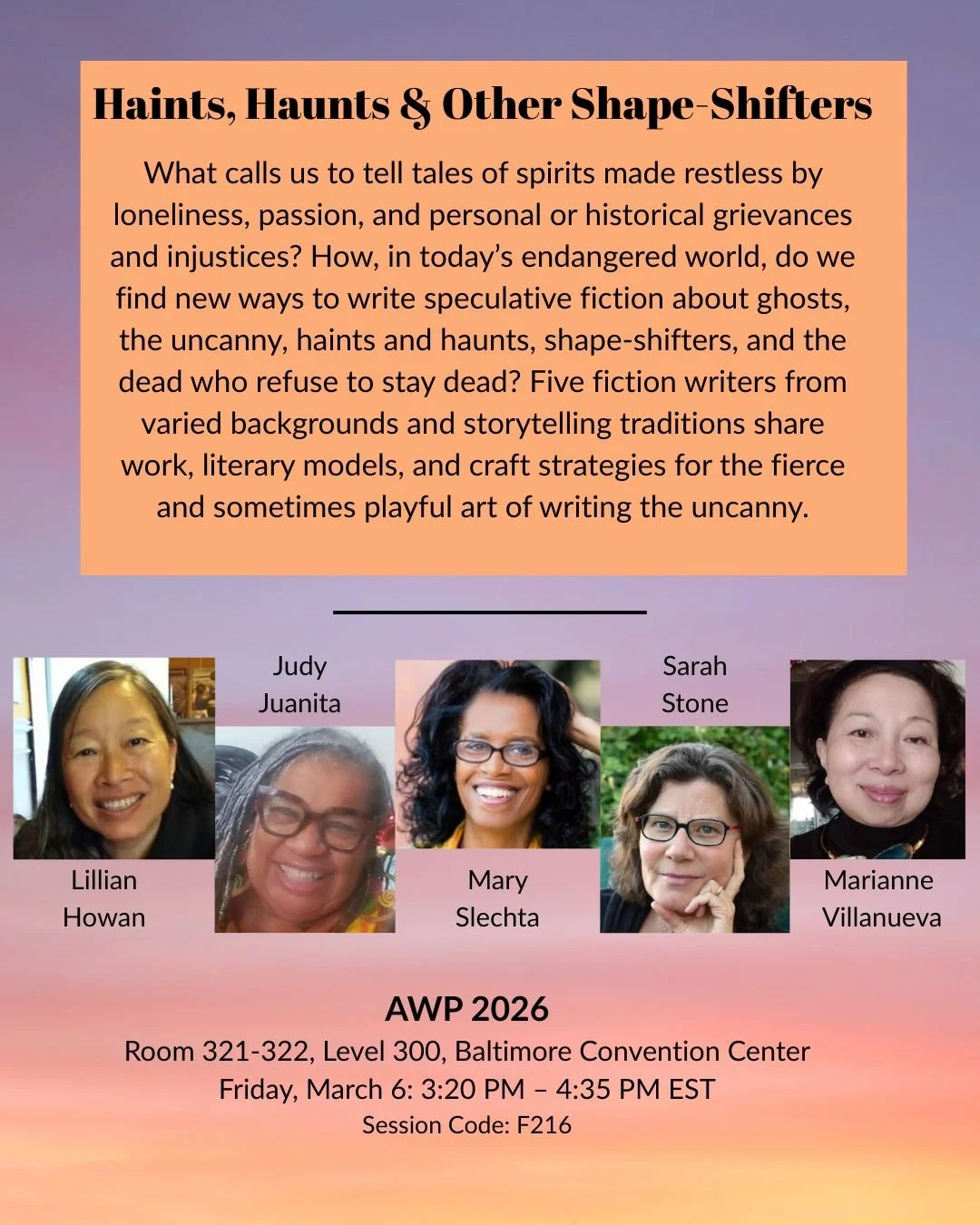
If you’ll be at AWP Baltimore, you can find me at four places for sure, and then at as many panels and events as I can make. On Friday March 6, from 11 am to 12 pm, I’ll be signing copies of Marriage to the Sea at the Four Way Books Booth, Number 1175, Bookfair. If you can come by, please do! Friday afternoon, I’m moderating a panel I’m very excited about, with a group of marvelous genius writers: Haints, Haunts, & Other Shape Shifters, Friday March 6, 3:20 PM - 4:35 PM, with Lillian Howan, Judy Juanita, Mary Slechta, and Marianne Villanueva. And I’ll also be in two off-site events: I’ll be reading at Across Time & Space: A Polyphonal Salon, Thursday March 5, 3 to 5 pm, Offsite Reading at Vinyl & Pages, 201 Light Street, Harbor Place (reading another writer’s work!) Autumn House Press and Friends, Friday March 6, 6 to 8 pm, with authors from Autumn House Press, Four Way Books, Carnegie Mellon University Press, and Barrow Street Books, at V-NO Wine Bar & Shop, 905 S Ann Street.

After AWP, I’m part of a virtual launch for Four Way Books: The Norwich Bookstore, Wednesday March 18, 4 pm PT (7 pm ET.), “Sarah Stone, Daniel Tobin, Daniel Barban Levin, Aiden Heung - A Virtual Evening With Four Way Books.” More information and registration here.
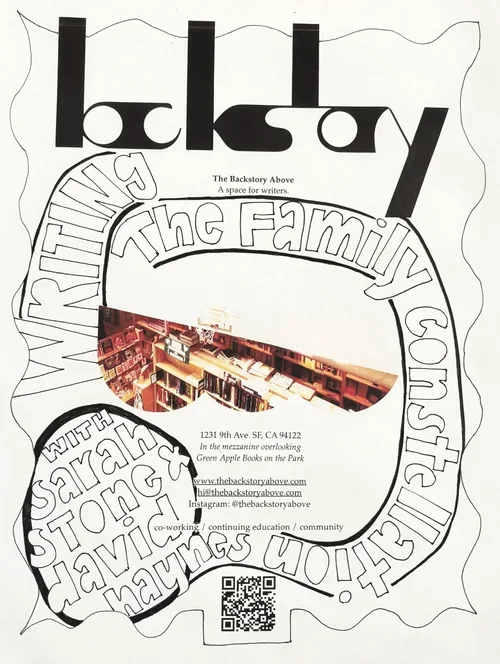
If you can come to a live event in San Francisco, Thursday March 19 from 6:30 to 8 pm will be my West Coast book launch, a reading and conversation with brilliant and fabulous writer David Haynes, a friend who makes everything more fun, and hosted by Paige Patterson Duff and Susannah Emerson at The Backstory Above, Mezzanine, Green Apple Books on the Park. It’s free, but you’ll need to RSVP here for the evening event. Live, in person, and we’ll have treats!

The next day, Friday March 20 from 2:30 to 5 pm David and I are teaching a class, also at The Backstory Above, on Writing the Family Constellation. Here’s our description: Families are full of constantly shifting dynamics and allegiances: feuds and friendships; competing interests, needs, and desires; disputed histories and circumstances. All of these become part of our projects, whether we’re writing a family saga that covers generations, a work that focuses on one relationship, or a piece that takes place over the course of an afternoon. This session is for writers at all levels and working in any genre, including fiction, essay, memoir, poetry, and plays. We’ll read short selections together, discuss the craft and process of writing families, and do a couple of writing exercises to explore family constellations from different angles. Along the way we’ll think about who gets included and how (are they central or peripheral?) and whether the piece stays with one speaker/central character or shifts among different consciousnesses and perspectives. We’ll also touch on the dynamics around writing family that happen off the page and the critical importance of dramatic irony when traversing the family multiverse. Please bring a pen and notebook or a laptop. Register here for the class.
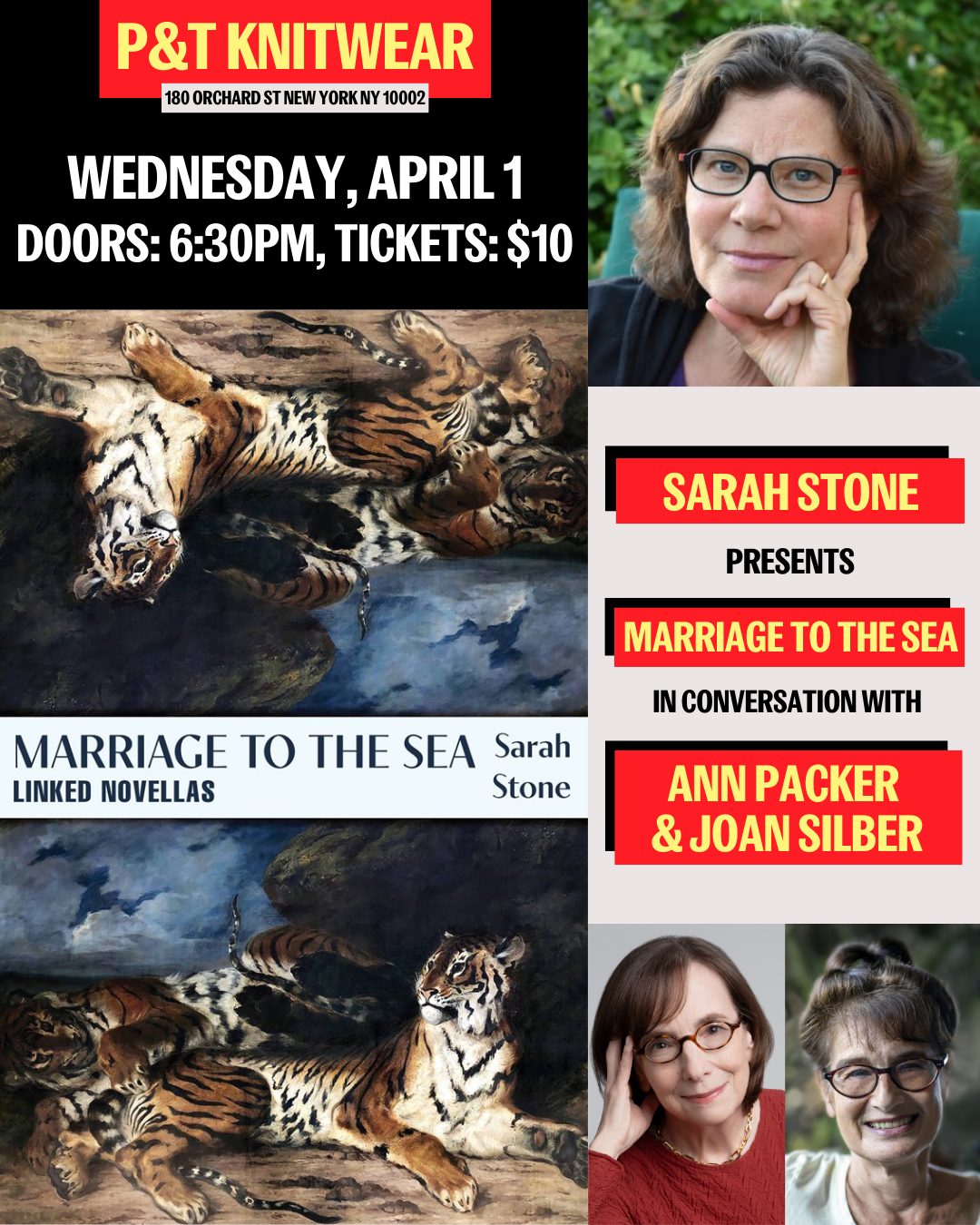
For those who can join us in New York City: “Sarah Stone presents Marriage to the Sea, with Ann Packer & Joan Silber,“ East Coast book launch: in-person reading and conversation, P&T Knitwear Books & Podcasts, Wednesday, Apr 1. from 6:30 pm to 8 pm. More info and tickets here.
And I’ll be part of a group reading in Marin County on May 8. You can find more info on my events page as they go live.
Hoping to see you soon! It’s been a stormy winter, but I am as hopeful as Elizabeth McCracken (I have inherited hopeful enthusiasm, as well as a tendency to pile up books to the point where strangers visiting our place almost always offer a joke, comment, or warning.) Looking everywhere for signs of spring: listening to those like Rebecca Solnit and Heather Cox Richardson who think that, with everything still to be cleaned up, and lots to be done and sorted through, there are, actually, reasons to hope.