
Allegra Goodman, This Is Not About Us
/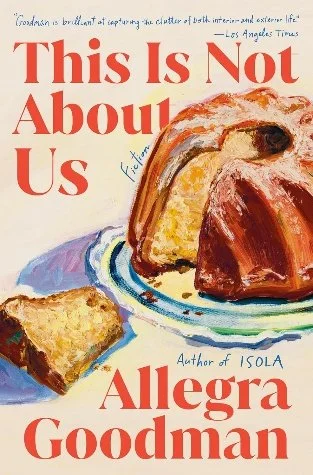
In one of the short stories/chapters of Allegra Goodman’s This is Not About Us, two sisters-in-law at a family Seder watch in horror as their husbands, brothers Dan and Steve, begin to fight over the pointed questions Steve’s asking Dan’s daughter Phoebe about the practicality of her new life as a professional busker: “Andrea and Melanie looked at each other in dismay. They maintained a certain bond, and they were wondering the same thing. Was this just a brief skirmish, or the beginning of a thirty-year feud? In the Rubinstein family, it could go either way.”
I read the book just after Passover on an airplane. I was coming back from the NY launch for Marriage to the Sea, followed by a family visit. All a huge pleasure. But I’d been running nonstop for a very long time, and reading far too much news, and plane travel is what it is. So I was grateful to disappear into Goodman’s characters, their daily lives and gently intransigent problems, seen with insight and humor. Especially since Goodman also drops plumb lines into the depths of those lives, giving emotional, psychological, even historical context to apparently lighter moments.
The book is organized around the rhythms of Jewish and family life. It feels as if it’s for both an insider and also outsider audience, with enough of the familiar to feel comforting and enough explanation or context to let others understand what that life is like. She gets quite detailed without ever getting bogged down in exposition. It’s always about the people and their story. I adored Sydney Taylor’s All-of-a-Kind Family books as a kid. Though very much for adults, Goodman’s fiction has some of the same pleasure of mixing learning and recognition.
The Seder chapter, “Redemption Song,” begins with its own epigraph (“In every generation, you should feel as though you personally left Egypt. —Haggadah”) and then gives the current family situation and the history behind it:
On Passover, Dan and Melanie hosted the first night, Dan’s brother Steve and his wife Andrea the second. Divide and conquer, Dan said. You don’t have to be so grim, Melanie told him. I’m not grim at all, he said. I just want to get it over with.
Passover was weighty for Dan, and for his brother too. It had been terrible for them, growing up. Their father, Irving, had been a survivor, and he’d ruined the holiday for everyone because it meant so much to him.
Irving had always been difficult, but on Pesach he spread misery, accusing Dan and Steve of misbehavior, fighting with their mother, finding fault with everything. More than once, Irving had left the table with a migraine—hinting darkly that they, the children, were the cause. Steve, the firstborn, had pushed back hardest, demanding, What did we do? Wide-eyed, Dan had watched. Of course, as adults, the brothers knew they had not been the cause of anything. Their dad was long gone, and they had long forgiven him, but they had a hard time celebrating. With seders looming, Dan became punctilious; Steve grew anxious and called often.
The families are serious enough about to be gathering for both first and second night together, and the opening questions (Why is Dan grim, why does he want this over with?) get an almost immediate answer. So there’s no narrative mystery, but instead a question about how this night is going to be different from all other Seders, what legacy the brothers are carrying forward and how it might erupt.
Goodman tells us the central, terrible fact plainly: Irving was a survivor. From that, we understand why the holiday meant so much to him, and Goodman doesn’t need to explain that. Where we do get details is in how he “spread misery.” There’s exactly as much about this as the book needs, without painful scenes where we live through it moment by moment. The focus is on the difference in how the brothers reacted. Steve, the oldest, pushed back. Dan, the baby, watched. Now Steve keeps reaching out, and Dan takes refuge in exactly following the rules.
Before we get to their present-day Seder, there are family struggles over food: who will eat what, who will be supporting (or not) other people’s practices and ethics, and what kinds of cleansing have to happen to prepare the house. Dan goes far beyond traditional purification practices and begins throwing out all kinds of food over Melanie’s objections. Next, he starts clearing out possessions, making Melanie feel “erased.” They are both tense: their daughter and her boyfriend are on their way, and they live in ways that trouble her parents (like Phoebe’s busking, though it’s a relief that she’s reconnected with her music). Dan and Melanie are planning to make a vegan Seder for them, which makes others in the family cross, and is potentially challenging, since they’re following Ashkenazi rather than Sephardic rules and have to eliminate tons of essential foods.
By the time the family arrives, everyone is already stressed. As they start the service, the kids are texting, tilting their chairs, and nothing feels like seder should feel, which upsets Dan. His response to this is so awful and so funny that I’m not going to spoil it. This is the short version of a description of the chapter: it all matters; in another way, none of it matters. The story could be as grim as Irving’s contagious misery, but Goodman’s dialogue and sharp observations of the nuances of family cross-currents make much of it hilarious, though still with that darkly tense undertone.
Andrea and Steve begin pushing Phoebe over whether she’s going back to school for arts administration (“Music is our lives, Phoebe explained.”). Dan blows up, and the brothers fight. Enraged and feeling crappy, Dan decides not to be part of their second night dinner, but Phoebe charms him into agreeing to go after all.
Dan drove, and Melanie carried the seder plate. Phoebe and Wyatt sat in back with a bowl of fruit salad between them. When they arrived, Dan handed Steve a case of Bartenura Moscato which was kosher, sparkling, and sweet. Melanie and Phoebe and Wyatt were all taking off their shoes because Andrea had a no shoes rule, but they looked up to see Steve accept this inexpensive offering. “I love this stuff.”
Dan said, “I know.”
Although nothing has been said in reconciliation, or even in acknowledgement that it’s needed, Steve understands the gift of the wine and Dan responds. I love that kind of subtext where people are basically saying almost exactly what they’re saying—it’s not buried but not quite on the nose, which would mean reconciling too fast. Steve might as well be saying, I know you’re mad, but I also appreciate that you’re trying. And Dan might be saying, yes, I am: this gesture isn’t accidental.
Then there’s the great description that reveals a lot about Steve and Andrea (we’ve had a bit of them before, but they really take center stage in a later story/chapter called, simply, “$”):
Steve’s house was small, and the seder table extended from the dining room into the living room. The extension was a wobbly card table for the kids, but white tablecloths covered the whole thing. Once you sat down, it was hard to get up because the space was so tight. Only Andrea could maneuver at the head of the table where she served the soup and led the singing.
While Dan was non-practicing Orthodox, Steve was egalitarian, which meant Andrea did everything. She had compiled her own Haggadah with readings from Emma Lazarus to Emma Goldman. At Andrea’s table, you never knew what would turn up. An orange for oppressed humans. A tomato for migrant farmers. A banana for refugees. It was like Melanie’s childhood seders where everybody took a moment to write a postcard on behalf of Soviet Jews. Cousin Wendy was there with her wife, Jill, and Nate had invited his girlfriend, Mackenzie.
They don’t have much money, and they believe in justice. (And “Steve was egalitarian, which meant Andrea did everything,” which made me laugh so hard that I got a dirty look from the guy across the aisle watching a horror movie on his phone. Sorry, guy.). The POV here seems wryly omniscient but it’s actually Melanie’s view and judgements, which we know from the reference to her childhood seders. (Interesting that the symbolism of the orange has become about “oppressed humans” instead of specifically being an acknowledgment of queer Jews.) This juxtaposition of the huge crises of the world and our small attempts to acknowledge them is, to me, funny and also poignant. But also fundamental to what the holiday is about. And the family addresses that directly:
Instead of taking turns, everybody read together. Instead of moving everyone along, Andrea stopped to ask deep questions. “What is freedom? What is it, Nate?”
“Um,” he said.
“Is it doing whatever you want?”
The seventeen-year-old knew better than to say yes.
“What is it? Other people? Dan?”
Dan shifted in his chair because he hated off-road Judaism. The unscripted seder. The personal connection. Although he felt oppressed by the old rituals, he preferred them, which was why he brought his own Haggadah.
“I’m not letting you off the hook,” said Andrea.
Dan sighed and said, “Freedom means making choices that are sustainable.”
“Great!”
“That’s beautiful,” said Cousin Wendy. Doubtless she thought Dan’s sustainable choices involved the ecosystem. In fact, he had been thinking of his daughter.
“Anybody else?” Andrea said.
Jill said, “Freedom is being true to who you are.”
Mackenzie was raising her hand as if she were at school. “Mom,” said Nate. “Call on Mackenzie.”
“Go for it,” Andrea said.
“Freedom is telling the truth.”
“Wonderful!” Andrea declared. “We have great definitions of freedom, but what is Redemption? Who wants to take a stab at that one? Zach?” She looked down the table at her older son.
“Being saved from sin, error, or evil,” he said immediately.
“He’s reading that off his phone,” Nate reported.
“Okay, who’s doing the saving?” Andrea pressed on.
“In what context?” Steve asked.
Andrea said, “You tell me.”
“In the Haggadah it’s God,” said Steve.
“Okay, it can be God,” Andrea said.
“No, Steve’s right,” Dan said. “It is God, literally.” He read aloud. “And the Eternal brought us forth from Egypt: not an angel, not a Seraph, not a messenger; but the most Holy, blessed be He, in His own glory.”
Look at you, thought Melanie. Rallying to support your brother.
What a delicious unrolling of quick, light, funny, serious conversation. This is only a piece of the scene, but it gives a sense of the fluidity of Goodman’s dialogue and the quick interiority that deepens our sense of the characters but doesn’t interrupt the conversation. I have probably mentioned before Steve Carrell talking about how he plays his characters as if they don’t know they’re in a comedy. This family does know they’re in a comedy, but they’re also really earnest. And after the struggles between Dan and Steve, Dan and Melanie, there’s a huge relief in this moment of connection.
The brothers aren’t through with their conversation, though the chapter, like most of the chapters, ends on an open, largely hopeful note. Rereading it, I’m struck by the attention to the structure, each moment, every detail.
On the plane, I forgot everything else and abandoned myself to living the lives of the Rubenstein family, thinking about the resonances with families I know, and so was able to avoid either obsessing about the national and international emergencies of day (or the hour). And also to avoid staring at the viscera on the screen across the aisle (had she just torn that guy’s guts out? Why was she sitting on those mossy steps looking so despairing, and what was she begging that other guy for?). Instead, I read This Is Not About Us, and I felt better about life and human beings. I could see some ways I could live a little differently, and that hope of improvement was another form of comfort.
My News
Grateful for my most recent conversations about the book, including my SF launch with David Haynes and my NYC launch with Ann Packer and Joan Silber, all of whom asked brilliant questions. Grateful also to everyone who came and joined in the conversations, including the conversation at my synagogue about dreams and family and the ways we get through, or figure out how to go on living with, grief. I appreciate all my reading and panel partners too. So much! (If you want to know more about those events, I wrote about them in my last MPP piece.)
My next public event, and my last for a bit, will be with the great new BAIT Reading Series: Friday, May 8 at 6 pm at the Sausalito Public Library. I’ll be reading and answering questions with Carvell Wallace (Another Word For Love), Chia-Chia Lin (The Unpassing), and Dāshaun Washington, hosted by wonderful Tanya Žilinskas.
Also, I was so happy to read this generous, thoughtful review in Alta by Ilana Masad: “Lives We Perform: Sarah Stone’s linked novellas in Marriage to the Sea follow a theatrical family through grief, love, and the complications of self.”
Meanwhile, I just want to say thank you to those who’ve been reading MTTS, writing me beautiful and intriguing notes and Amazon/Goodreads reviews (I wish these reviews made less of a difference than they do, but they have all kinds of weird effects, including showing up in WorldCat and therefore influencing which libraries might get, or bypass, the book). If you’ve been thinking about reading MTTS but new books aren’t in the budget right now, libraries actually buy books from patron requests, which means that others get to read it as well. Thanks to everyone helping as I launch this book into the world.
I’m also just glad to be in company with you, in whatever ways work for you, whether or not you’re reading or still thinking over whether you want to read MTTS, or are mostly here for the discussion of other people’s books. As long as we’re thinking about books and stories, we’re all part of the same mycelium network of storytelling. Glad to be here with you.