
Ruth Ozeki, The Typing Lady
/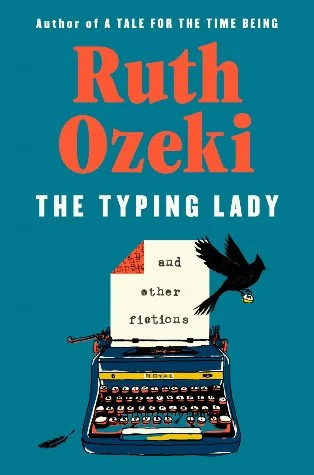
The epigraph of Ruth Ozeki’s first book of stories is Elizabeth Bishop’s “One Art”: the entire poem, as if a line or a stanza about loss isn’t enough, but the reader needs every shift, denial, and detail to understand “the art of losing isn’t hard to master.” Ozeki, novelist, Zen priest, former documentary filmmaker who learned how to put a story together by making these films, has a generous, amusing, piercing sense of how people suffer, lose, get lost, and learn to look after each other. Without being explicitly didactic, these feel like teaching stories that could change the ways a person lives in the world or imagines other people.
For one thing, the stories often embody a movement towards generosity and a larger understanding. Many of the stories, and perhaps the book as a whole, start from a sense of characters’ grievances and complaints, but open out into compassion. Sometimes this is explicit, as in the story “Feelings,” in which a pair of school girls are given an assignment to demonstrate compassion and empathy. The game they play turns into a luxuriant descent into pity and invention about the lives of those they’re more or less attempting to feel compassionate about. But even when they finally begin to develop awareness of what it might be like to really suffer, it’s still easier for them to be compassionate in storytelling than in reality.
“Leaf Blower,” a story about a young woman pressed into a daughter role with her aging landlords, moves from the indignities of the assaults of machinery (those leaf blowers), the natural world (an out of control shrub and an obsessive cardinal), and job duties (more and more work and an assumption of obligation) to the pleasure and comfort of acceptance, of caretaking.
In “Ships in the Night,” Cayenne and her daughter Baby move from place to place, following Cayenne’s love affairs and departing as these go wrong. Cayenne uses her typewriter to create an endlessly changing romance. This passage shows them in transition:
They reached Vancouver and slept in the car until Cayenne hooked up with Guy. He had an extra room, which he said they could use until they found a place of their own, but Baby knew it wouldn’t take long for things to get romantic.
In Vancouver, Cayenne gazes out “past the dirty rooftops, splattered with seagull shit, to the ragged, snow-capped ridge just visible beyond.” She talks dreamily about the mountains and having room to breathe. The narrator tells us, “Her eyes were like hot stars on Baby’s horizon.” And that sends us into this flashback:
Baby remembered the stars.
“It’s all about experience,” Cayenne said, as she drove the battered Chevette through the star-filled desert night. “Real-life experience. A writer needs that, you know?”
Baby nodded. She didn’t go to school much, but she had plenty of real-life experience.
“I’ve got it all figured out, see? The heroine is from Texas. From El Paso. Maybe she’s the daughter of a rich oilman who falls in love with a musician. What do you think?”
Baby turned to face her mother, leaning back against the car door and stretching her legs so her feet rested on Cayenne’s lap. The window knob dug into her backbone. “Is she beautiful?”
“Of course she’s beautiful,” Cayenne said. “Is your door locked? I don’t want to have to circle back and scrape you off the tarmac.”
Baby twisted and punched down the button. “How beautiful?”
“Extremely beautiful. The most beautiful girl in all of Texas. She’s got flaming red curls and a temper to match. Like you, Baby. She gets her looks from her mother.”
Cayenne’s profile was the only thing that stayed the same—her face encircled by the moon and stars, framed against the landscape, blurred by speed.
“The musician guy…is he a guitar player?”
“Hmm.” Cayenne tilted her head. “That’s a good idea. Should he be?”
“Yeah,” Baby said. “A guitar-player creep.”
Cayenne glanced over. “You glad we left El Paso, hon?”
Baby nodded.
“Well, I think you’re right,” Cayenne said. “We needed some distance. You can’t write about a place until you leave it behind.”
There’s so much compassion for both characters—Cayenne, with her endless dreams of the promise of her life and her book, and Baby, wanting to be part of her mother’s world, to consent to their lives. Baby seems to be Cayenne’s embodiment of her one reader, the one who can assent to the plot, maybe reflecting Ozeki’s own strong sense of writing as a collaboration between writer and reader.
As the story progresses, Baby’s feelings about the constant moves become complicated. Still, in their changing life, her mother is the only constant. That shows up here in the image of her profile (“the only thing that stayed the same,” but Baby still only sees her from the side), the romance of moon and stars, the framing of the landscape as she takes her from place to place, that sense of what it means to be “blurred by speed.”
But Cayenne, however casually she expresses it, is also very much a mother. How different her character would be without that “Is your door locked? I don’t want to have to circle back and scrape you off the tarmac.” She’s making a joke out of it, but she’s aware of Baby and, despite everything, looking after her. There are no villains here, just a glimpse into this complicated, entangled pairing, and a sense that further movement lies ahead.
Several stories also began as responses to invitations and commissions and have some of that playfulness of working with someone else’s themes or prompts. Most of the stories still have Ozeki’s ebullience, grit, and awareness of environmental peril. All of the stories have typewriters. Ozeki is probably at least in part joking when she says in interviews that she began buying typewriters and included them in the collection for tax purposes (not the only place where she speculates tacitly about how one lives as a writer, including in the stories as well as interviews). She so loves language, objects, books we talk to and books that talk to us, and ideas about how we use machinery and vice versa. But in choosing typewriters as a linking element, she’s made room for a lively game of imagining who would use what kind of typewriter and what they would do with it.
Ozeki also talks in interviews about being a novelist who’s learning to write short stories because she’s been teaching story writing and wants to avoid a feeling of fraudulence, and also because she’s aware of passing time and spends so long writing her rich, extraordinary, digressive, multifaceted novels. She’d like to tell more stories than she ever can in the time she has left.
My news
Apart from the very occasional podcast or interview (you can find that info on my news, media, and interviews page), I’ve been plunged into a late-stage revision of my next book of fiction. Although my term has started, and there are a lot of intense and beautiful online and Zoom conversations going on with the writers studying voice, I’m spending some time, even if it’s only fifteen minutes, or on a great day, an hour, in the world of my characters, even as I keep talking with people about Marriage to the Sea.
And speaking of which, it’s time to do what is, for many of us, the most challenging part of the publishing process—asking for favors: if you have read Marriage to the Sea and liked it, would you be willing to write an Amazon/Goodreads review? Even if you’re shopping entirely at indie bookstores, these reviews make a weirdly big difference in terms of letting readers take it seriously enough to actually look at it in a sort of friendly and inquiring state of mind. And then those people who might like it can find it.
Don’t worry if you haven’t yet read it or can’t bear writing reviews—I totally understand and am not tracking who is reading and when. We all have such huge TBR stacks. There are books I really want to read but which take me a very long time to get to if they arrive in intense work periods or with a flood of other new books. Thank you for considering it!
As always, I’m reading the news and trying to figure out our avenues out of the hellscape. Right now I’m most of all supporting those fighting in the courts and those fighting redistricting. I’m also surrounded by people doing great work, in city government, in the parks, as activists and volunteers. There’s reason for hope in that. Meanwhile, I’ve been reading some gorgeous books as well as The Typing Lady, including books by friends and writers I know. Louise Marburg’s Fancy Meeting You, a hilarious novel in stories that’s also a lesson in how to create a complicated, problematic, lovable protagonist. And Martha Conway’s gripping, haunting We Meet Apart (the unexpected ending blew me away). And Chia-Chia Lin’s unforgettable family journey, The Unpassing. Deb Olin Unferth’s Earth 7!
And then I finally read, and loved, Rachel Aviv’s long, rich portraits of people wrestling with their minds in all kinds of different life circumstances, Strangers to Ourselves: Unsettled Mind and the Stories that Make Us. It’s both very specific to each life, but also giving rise to piercing questions: “The divide between the psychic hinterlands and a setting we might call normal is permeable, a fact that I find both haunting and promising. It’s startling to realize how narrowly we avoid, or miss, living radically different lives.”
Wishing you all the best possible month ahead, with all the lives you’re living or imagining.