
Melissa Pritchard on Mavis Gallant’s “The Ice Wagon Going Down the Street”
/
(Guest post by Melissa Pritchard)
“I have lived in writing, like a spoonful of water in a river.”
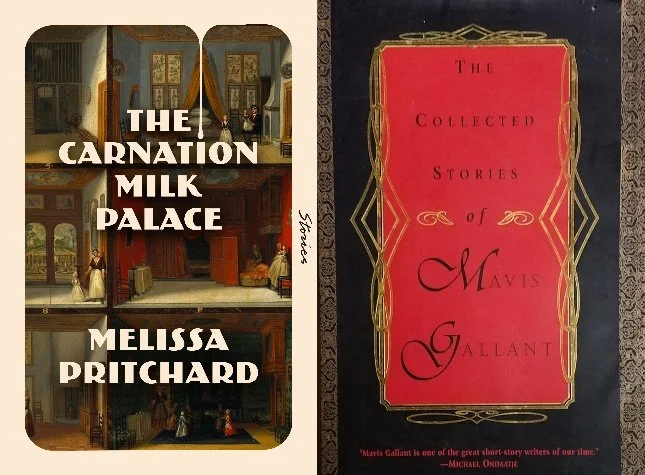
—Mavis Gallant, in the preface to The Collected Stories of Mavis Gallant
In the early 1980s, few MFA Creative Writing programs existed in this country. As a midwestern housewife and mother, lacking time or money for any writing program, I taught myself to write fiction. My “method?” First, read a story for pleasure, then fillet it sentence by sentence, paragraph by paragraph. After that, dismantle the story’s architecture until the structure and foundation become clear. Finally, handwrite, then type, a similar or “shadow” story, followed by a dozen or more revisions. Imitation is a classic form of learning, but for me it became a pragmatic substitute for instruction I couldn’t afford. My first book, Spirit Seizures, recipient of the Flannery O’Connor and Carl Sandburg Awards, is a collection of these early stories.
Most writers would rather speak about the authors who have influenced them, authors they admire, than go on too much about their own work. In interviews, Mavis Gallant credits Marcel Proust, F. Scott Fitzgerald, Eudora Welty, Albert Camus, Colette, Nabokov, Elizabeth Bowen, Marguerite Yourcenar, Chekhov—particularly Chekhov—as influences. Cautious when asked about her own writing routines, personal habits, or the recurrent themes and patterns in her stories, she said in an interview with Stéphan Bureau for BRICK, A Literary Journal, Issue 80, “I’m not a teacher and I can’t analyze what I do…. Other people tell me things that amount to clichés. For example: ‘All of your subjects are about exile.’ That’s not true…If I analyzed what I’ve written, I wouldn’t amount to much. I’d have nothing left.”
Gallant died in 2014 at the age of 91. Autonomy and anonymity were her guardians; she deliberately arranged her life around her writing and kept that life as private as a walled garden. She was critical of readers’ fascination with the personal lives of writers, with the scurrilous, titillating, or tragic details of any artist’s celebrity or notoriety.
In her conversation with Bureau, she said,
MG: We need to separate the artist from the art. Visitors wouldn’t look at anything in museums if they knew everything about all the painters. We’re now living in an age that is extremely open, but, on the other hand, it is a puritanical age; and people want to know about the individual, his life, what the person does. More and more biographies of writers and artists are being written in an attempt to bring them down a notch…. More importance is attached now to the biography of an author or painter than to the writer or artist. Just look at the frenzy surrounding Picasso—the women he married, the mothers of his children. What difference does any of that make? It’s irrelevant.
SB: Only the paintings matter?
MG: Only the work life. That’s the life that matters.
In a fascinating Canadian television interview recorded in Paris in 1963 (and still available on YouTube), Gallant says she first began writing poetry, followed by plays, before committing, nearly exclusively, to the short story form.
Plays! For a brief time, during and after university, I had been an aspiring actor. That Gallant, too, had been drawn to theater, had written plays, suggested a new way of looking at her fiction. Her stories proceed as plays might, scene by scene, act by act, the tension tightening, noose-like, before it is released. A Gallant story might end with a cathartic snap or a lingering open note, but always there is astringent, reverberant clarity. Settings and props are chosen with a playwright’s care.
Of all Gallant’s stories, I am most haunted by “The Ice Wagon Going Down the Street,” a story about self-delusion and the sad circularity of hope, originally published, like all her stories, in The New Yorker. In the opening scene, Peter Frazier and his wife, Sheilah, are sitting in Peter’s sister Lucille’s cramped kitchen in Toronto. Wearing silk dressing gowns from Hong Kong, they drink coffee and reminisce over their peripatetic failures in world affairs, repeating remembered names and places like sacred talismans. A large steamer trunk that has gone everywhere with them—Paris, Geneva, Hong Kong, Ceylon—“blocks a corner of the kitchen, making a problem of the refrigerator door; but even Lucille says the trunk may as well stay where it is, for the present. The Fraziers’ future is so unsettled; everything is still in the air.”
Here are the story’s opening lines:
Now that they are out of world affairs and back where they started, Peter Frazier’s wife says, “Everybody else did well in the international thing except us.”
“You have to be crooked,” he tells her.
“Or smart. Pity we weren’t.”
It is Sunday morning. They sit in the kitchen, drinking their coffee, slowly remembering the past. They say the names of people as if they were magic. Peter thinks, Agnes Brusen, but there are hundreds of other names…
The dialogue cleverly encapsulates the entire story. Sheilah appears to be smarter than Peter, certainly more realistic, while Peter’s secret thoughts about Agnes Brusen introduce a note of marital suspense that will expand and deepen as the story progresses.
Peter Frazier is the descendant of a wealthy, important Canadian family. His deceased father, having lived an extravagant life beyond his means, has left Peter a limited inheritance and a surname with fading cachet. His wife, Sheilah, a former model in London, grew up “rat poor.” Her chief currency is her physical beauty; her survival instincts express themselves in a cynical social charm and quick, resilient intelligence. Peter and Sheilah are inextricably (sometimes inexplicably) devoted to one another; by today’s psychoanalytic standards, they might be seen as dangerously codependent.
Early in the story, an inebriated Peter misbehaves at a friend’s wedding in Paris. He is consequently demoted, sent away by some nameless authority to pinch out a living as a file clerk in Geneva.
After four months, they were suddenly moved away from Paris, but not to Germany – to Geneva. Peter thinks it was because of the incident at the Trudeau wedding at the Ritz…. At the wedding reception, Peter lay down on the floor and said he was dead. He held a white azalea in a brass pot on his chest, and sang, “Oh hear us when we cry to Thee for those in peril on the sea.” Sheilah bent over him and said, “Peter, darling, get up. Pete, listen, every single person who can do something for you is in this room. If you love me, you’ll get up.”
The scene is both shocking and funny—a drunk sprawled on the floor at a formal wedding reception, a pot of azaleas on his chest, singing a British Naval hymn for seamen in distress. Pathetic, horrifying, and a career catastrophe for Peter Frazier.
In Geneva, at first, Peter “works” alone in a drab office, hardly working at all. Then a second Canadian, a young Norwegian woman from Saskatchewan, is brought in to be his boss. Agnes Brusen is brown and small, burdened-looking and round-shouldered. Peter describes her to his wife as a “mole-faced virgin.” Agnes decorates her desk with a large, black Bible which she regularly dusts but never opens, a small vase of anemones, and a box of Kleenex. She removes a Charter of the United Nations from the wall and replaces it with her framed university degree. This “odd couple,” Peter and Agnes, co-exist uneasily in their cramped, ugly office; for the reader, their strained relationship approaches comedy. Humor in Mavis Gallant’s stories is important for its leavening effects; her wit is sly, slightly wicked, never mean.
Peter feels certain he is the superior in this unfortunate relationship until Agnes unwittingly reveals she is being helped by the Burleighs, a socially prominent couple in Geneva. The Burleighs have two ranked guest lists, and unbelievably to Peter, Agnes turns up on the first, the important, list. In a wink, he sees his social position upended, with Agnes oblivious to her privilege and Peter agonizing over his inferior status.
Like Peter, Sheilah has committed a social faux pas, charging a skirt to Mrs. Burleigh’s account, even though she had been told she could: “Poor Sheilah! She was new to this part of it—to the changing humors of independent friends.” She recovers herself at a Mardi Gras costume party given by the Burleighs, flirting with a susceptible businessman. Meanwhile, an intoxicated Agnes, with Peter as her assigned escort, stumbles through a snowstorm to her dreary, freezing apartment. While nothing “happens,” between the two, a good deal, undefinable and vaguely troubling, does happen. Eventually, Peter and Sheilah are given a second chance by the enamored businessman and relocated to Ceylon.
Clothing is significant in this story. Agnes’s humorless work ethic, her “mole-ness,” are reflected in her dull plumage. At work, she alternates a brown tweed suit with a navy-blue dress with changeable collars. Sheilah zips herself into her black Balenciaga whenever possible—a remnant of her former life in high fashion. Peter and Sheilah wear silk gowns from Hong Kong, seemingly as a “private joke,” but like peacocks, they preen, peck at gilt memories and important names, waiting to be saved from Lucille’s kitchen and her Presbyterian rigor—expecting, any minute, to be whisked off to another foreign mission. Throughout the story, Sheilah’s Balenciaga suffers its own sartorial fate:
In Geneva, where Peter was a file clerk and they lived in a furnished flat, she pretended they were in Paris and life was still the same. Often, when the children were at supper, she changed as though she and Peter were dining out. She wore the Balenciaga and put candles on the card table where she and Peter ate their meal. The neckline of the dress was soiled with makeup. Peter remembers her dabbing on the makeup with a wet sponge. He remembers her in the kitchen, in the soiled Balenciaga, patting on the makeup with a filthy sponge. Behind her, at the kitchen table, Sandra and Jennifer, in buttonless pajamas and bunny slippers, ate their supper of marmalade sandwiches and milk. When the children were asleep, the parents dined solemnly, ritually, Sheilah sitting straight as a queen.
The couple clings to their diminishing status, to the fading name of Frazier, to the Parisian aura around a black afternoon dress, both making believe, like spoilt, shipwrecked children, that they are better off and far luckier than they actually are: “The Balenciaga is their talisman, their treasure; and after they remember it they touch hands and think that the years are not behind them but hazy and marvelous and still to be lived.”
Having been bailed out, once again, by Lucille’s dependability and tired loyalty, with the fate of their two “sandy-colored, proudly plain,” daughters hinging on their quixotic parents’ next move —with the reader knowing, even if the Fraziers themselves can’t admit it, that this time their luck has likely run out and what remains is a shared, delusional faith in infinite chances, the story concludes the way it began, in a Toronto kitchen, with Peter and Sheilah grasping at outdated stories and a steamer trunk blocking the refrigerator door.
Midway through the story, the origin of Peter’s delusional air of entitlement is made clear:
He has often tried to tell Sheilah why he cannot be defeated. He remembers his father saying, “Nothing can touch us,” and Peter believed it and still does. It has prevented his taking his troubles too seriously. Nothing can be as bad as this, he will tell himself. It is happening to me. Even in Geneva, where his status was file clerk, where he sank and stopped on the level of the men who never emigrated, the men on the bicycles—even there he had a manner of strolling to work as if his office were a pastime, and his real life a secret so splendid he could share it with no one but himself.
I am convinced that the human capacity for denial is a wired-in survival instinct. To blind oneself to an ugly truth staring one right in the face is a talent as common as birth. The Fraziers cannot, will not, see their descent for what it is, a mutual failure of character. To admit they have bottomed out, that rescue may not come this time, is unimaginable. As with their exotic dressing gowns and Sheilah’s soiled Balenciaga, they deny their awful circumstance by cloaking themselves in unfounded hopes and memories of former grandeur.
Each time I return to “The Ice Wagon Going Down the Street,” I glean some fresh detail or correlation, feel some new wave of pity for Peter Frazier, Agnes Brusen, even Peter’s colorless sister, Lucille. Gallant’s uncanny literary brilliance spurs me to pay closer attention to my own work, to recognize when I am stopping short of complexity, either through unintentional laziness or an unconscious resistance to hard truths. She reminds me not to judge my characters, but to regard them as an anthropologist, sociologist, or Jungian analyst might, down to the most singular, jolting detail. No one, her stories imply, escapes the flaw of being human; a writer must cultivate powers of listening and observation to better plumb the pathos and courage, the sorrows and hilarity—the whole entangled, contradictory weave of human life.
In the title story of my new collection, The Carnation Milk Palace, 14-year-old Charlotte Massey’s middle-class parents are upwardly striving, socially ambitious, discontent yet seemingly stuck. Charlotte’s mother, Hazel, compares her life unfavorably to the lives of her wealthiest friends, Glen and Stibsy Halden. Invited to the Halden’s annual New Year’s Eve party, Charlotte’s parents insist, this year, on bringing Charlotte along.
The Masseys attended the Halden’s New Year’s Eve party every year, and for two or three days afterward, Charlotte’s mother boiled over with rage. Compared to the Halden’s, her life came up irredeemably short, and she took it out on everyone and everything around her.
Hazel Massey’s embittered history is that she had, at one time, been courted by rich but boring Glen Halden; had she married him instead of handsome, taciturn Jack Massey—well, she could hardly bear to imagine how much better her station in life would be now.
While the Massey’s tortured attention to social status is similar to that of Peter and Sheilah Frazier’s, the story is told from Charlotte’s perspective. Her parents’ materialism, discontent, and anger are the toxic environment in which Charlotte’s silent rebellion blooms. Clothing signifies in this story as well. Mrs. Massey tells her daughter exactly what she is to wear to the party to be “acceptable,” while she changes at the last minute from turquoise capri pants and matching top to a black peplum sheath with a slim rhinestone belt. A black Persian lamb coat belonging to Mrs. Massey’s grandmother, brought out of mothballs on special occasions, reappears in the most wounding part of the story.
Counterpoint to the Halden’s inherited opulence and the Massey’s envy of their luxurious friends, Charlotte’s best friend, Moira Duffy, comes from a poor, large and rambunctious Catholic family. Charlotte’s parents do not like Moira; they fear her lower-class, bohemian influence on their quiet, impressionable daughter. Values and ideals collide in this story, and even as the Masseys continue to exert outer authority over their daughter, Charlotte’s rebellion, like a buried seed, begins to root and take hold:
Later, in bed, Charlotte imagined ways to tell Moira about the New Year’s Eve party—the Haldens, the Milk Palace, the champagne, the stupid dancing, her mother’s embarrassing flirtation with a college boy who would follow Charlotte up the stairs into a dark bedroom, his French-kissing her, half undressing her, then leaving her, respecting her or saving himself, who knew, but the first boy ever to tell her what she most wanted to hear, that she was beautiful.
Mavis Gallant’s stories emboldened me to break open sentences, risk making room for surprises, follow a story’s thread-like capillaries, let go of the false safety of fixed plots, and trust each story’s unique, organic structure, its reflection of the burgeoning, untidy world.
Gallant’s complex sentence structures, her deft switching of narrative perspectives and cinematic shifts in chronology, her scalding yet nonjudgemental psychological explorations of character, inspired me to question my internalized “rules of fiction,” rules threatening to narrow my stories to a tired, prescriptive scope. With The Carnation Milk Palace, I began to slip free of old rules. I eavesdropped on characters, observed what they did and what they wore, how they moved through the world, independent of my own nervous insecurity and at times, clumsy interference. It was liberating and terrifying to write in this new, Gallantian way, unleashing characters, relaxing tight story lines. I have even come to believe that a story exists before my conscious awareness of it, that a host of characters quietly waits for me to discover them. It has become my task—and no task at all, but an act of devotion in this new role as part-amanuensis—to observe and listen, feel pity and compassion, and then, as best I can, take it all down.

PHOTO: Morgan Duke
Past finalist for the PEN Nelson Algren Fiction Award, Melissa Pritchard’s fiction and non-fiction have appeared in The Paris Review, A Public Space, Ploughshares, O, The Oprah Magazine, Ecotone, Conjunctions, LitMag, The Chicago Quarterly Review, The Georgia Review and over seventy other magazines, anthologies and journals. She has received a National Endowment for the Arts Fellowship, three Pushcart Prizes, two O. Henry Prizes, the Flannery O’Connor Award, the Carl Sandburg Literary Award, the Kafka Fiction Prize and a Marguerite and Lamar Smith Fellowship from the Carson McCullers Center. Two of her books have been named New York Times Editors Choice, another received a Barnes and Noble Discover Great Writers Award. Others have been named “Best Books of the Year” by the San Francisco Chronicle and the Chicago Times. One of her story collections was a National Public Radio Summer Reading” selection and her fifth, most recent and highly acclaimed novel, Flight of the Wild Swan, was featured on NPR's "All Things Considered" and Georgia Public Broadcasting's "Narrative Edge." Professor Emeritus at Arizona State University and past fiction editor for IMAGE Journal, Melissa's twelfth book, a story collection entitled The Carnation Milk Palace, will be published in January 2027. A native of California, she is married to Dr. Philip T. Schley and lives in Columbus, Georgia.