
Leah De Forest on Jung Yun’s All the World Can Hold
/
(Guest post by Leah De Forest)
Once or twice a month I get a tiny jump-scare when it occurs to me, afresh, that I’m a creature peering out at the world from inside my own small skull.
It’s a normal-sized skull, as far as I know—but relative to, say, the circumference of the planet, the size of the Pacific Ocean, North America, Massachusetts, or even the distance between the room in which I’m now sitting and the one in which my dog is barking at some unseen interloper (most likely the long-suffering mail carrier), I am but a tiny dot.
I’ve come to see that for me, this gap between the self and the world, and all the ways in which we work to bridge it, is One of Those Subjects: the central point in the dog bed I’m circling, to which I’ll always return. I’ve used “gap” in the singular, but I think of it as radial: the individual, mundane (dog barking by the door); familial (in even the tightest knit group, each member living in their own reality); and societal (how on earth do we all manage to agree on what’s going on out there?). In this context, big global events are especially intriguing. Meaning percolates up through individual experiences (so many human dots) and into shared stories that seem both fixed—a matter of public record—and contested. Not only that. These global-scale events can come to seem so obvious, so known, that they feel beyond language. How to get all this on the page?
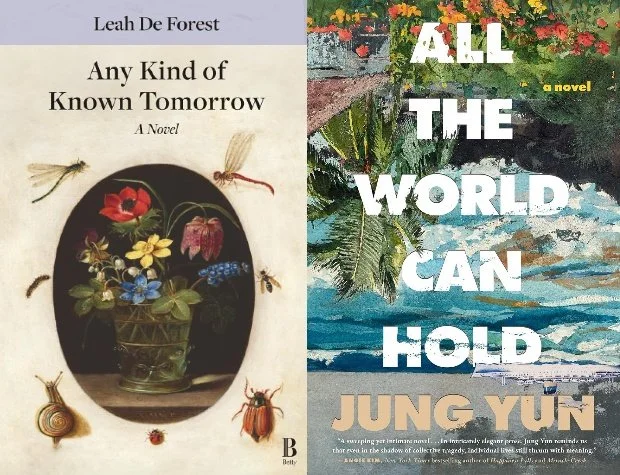
Jung Yun’s 2026 novel All the World Can Hold, which is set on a cruise ship a week after 9/11, uses individual experience as an entry point to the collective. The story follows three focal characters: Franny, who is pushing ahead with a family cruise to celebrate her mother’s 70th birthday; Doug, a former TV star who is less than thrilled about joining a reunion cruise; and Lucy, a young MIT graduate student who made a last-minute decision to join her roommate on the cruise. All have mixed feelings about being there. Close proximity places pressure on their relationships, and the fact that satellite communications are down adds to the sense of floating “outside” of reality.
Tragedy is on every page, even when no one’s talking about it. For example: early in the novel, Franny and her husband Tom, who are from New York City, encounter a group of cruisers from other parts of the country. Tom knows it would be polite to lie, but—ragged with grief—he tells the group where they’re from: “The couples stop chattering. The wife of the man with the hearing aid almost shouts at him: ‘They’re from New York City.’ At this, the man’s whiskered gray face collapses.”
How impossible it can feel to talk about something that threatens to swallow us.
All the World Can Hold’s action takes place over the course of five days, from 9/16/01 to 9/21/01, as the cruise ship Sonata sails from Boston (rerouted from Manhattan) to Bermuda and back. Yun told Literary Hub that she’d been trying to write the novel on and off for 20 years, and that the story draws on personal experience—she, too, went on a cruise to Bermuda on 9/16. It was a Love Boat reunion cruise. She had just arrived at her office on the West Side of Manhattan when the first plane hit.
Yun, like her characters, had her individual experience of 9/11; the novel reaches beyond that. Which brings me to the technical aspect of this book that excited me. As I noted, Yun uses rotating close third person (which we could also call rotating limited omniscience). The focal characters switch at the chapter breaks. This maintains a sense of separation between the characters, and also establishes a pattern: Franny, Doug, Lucy; Franny, Doug, Lucy; Franny, Doug, Lucy. The characters’ arcs complicate through the novel’s first half: Franny’s marriage looks shaky, Doug is forced to face the consequences of years of substance abuse, and Lucy wrestles with what she truly wants to do with her life. All while the passengers are cut off from the wider world. And then, right around the novel’s midpoint, this:
The passengers descend, five and six abreast down the ramp, feet tentative as they reacquaint themselves with land. Within minutes, they funnel through the arrivals building, collecting maps and brochures by the handful even though they only have a day to explore.
Outside the arched doors of Heritage Wharf, dozens of Bermudians—"Onions," the guidebooks call them—await the ship’s arrival …
The Onions say the passengers are lucky. September is an unpredictable month for rain. But the day is as fine as any during the height of peak season. Seventy-eight degrees with a light northwesterly wind, the kind of weather than makes the passengers happy to be alive. They’re tempted to close their eyes and let the sun warm their faces, but they can’t, not when the sky demands their full attention. It’s bright blue and clear, without a cloud or contrail in sight. It’s the same sky that everyone was talking about a week ago, which reminds them that it’s been exactly one week. One week since the world changed, and yet here they are.
The narrator has of course been there all along, giving us access to Franny, Doug, and Lucy; here, at the novel’s hinge point, she steps forward and speaks in her own voice, giving us access not to one individual mind and body but to a collective. When the passengers step, blinking, out into a bright world that also offers two days of missed news, Yun’s narrator hovers over the group, imparting their shared knowledge as they acquire it. Shortly after the paragraph I quoted above, she offers this:
Among the things they learn soon after their arrival: Lower Manhattan is still burning, and what was once known as "the pile" now has a new name. Ground Zero. All over New York, shop windows and subway stations are papered with flyers that ask HAVE YOU SEEN MY SISTER? DO YOU KNOW THIS MAN? CAN YOU HELP US FIND OUR DAD?
The narrator continues‚ moving from Washington, D.C., to Shanksville, Pennsylvania, flags across the country flying at half-mast. The passengers, she tells us, “…do their best. They can’t change the fact that they’re here, so they sun themselves and shop and take photos and buy trinkets by the bagful. But there’s simply no escaping the news.”
The passengers return to the ship sobered, and yet, somehow, they must prepare for two more days of celebration dinners and special entertainments. And now we’re back to the pattern: Franny, Doug, Lucy. The story may be once again contained on the ship, but the closer the Sonata gets to home, the more present the wider world becomes. At the novel’s end, the omniscient voice returns, inhabiting what the characters know, and also what they do not: the way they will one day reflect on their strange cruise experience, and the many ways the world changed after 9/11.
Readers, of course, also know how the world changed in the aftermath of that tragedy, information drawn from news coverage, books, and other sources of shared knowledge—in addition to their own private experiences. Yun’s narrator—or, more precisely, the book’s narrative consciousness—appears aware of that, and the novel benefits from it.
I don’t mean to suggest that it’s possible for writers to predict precisely what future readers might know, or how readers might feel about the events of any given time—any more than it’s possible to read the mind of the person who might be sitting next to you on the couch (or across from you on a train) while you read this essay. At the moment of writing, I can’t even be sure that you’re out there. Hello?
Here’s what I do know. I felt safest, as a child, when I was meeting another mind in the quiet of the page. Reading is a magic act, a real-life form of mind-reading, a leap from one hopelessly contained skull into another. I read and write fiction because that feels like home to me.
There’s a connecting thought here, but I can’t quite find it, so I’ll say this:
I wrote a pandemic novel. I didn’t start out there. I finished a draft, in 2019, of a novel about mothers and daughters that included a pandemic in Brooklyn, New York. Come 2020, when it was time to revise, the real big world accelerated right into my private life. Into all our private lives, in ways that have slipped in and out of language in the years since. It felt important, because I was in the work of the novel, to try to render my characters’ experiences as this baffling and frightening new reality unfolded. In that draft, Any Kind of Known Tomorrow also broke away from a kind of serial third person into omniscience. This allowed the narration to sweep across oceans and down into the earth, reading the minds of every individual at a dinner table and also having access to that day’s news. That kind of knowledge is completely fictitious, and yet it also seems, somehow, possibly, real. There’s a whole big world out there.
I guess what I’m saying is that when I came across Yun’s novel—some months after my novel was “done” and several more before its expected release—my book-brain felt it had found a book friend. I was thrilled to see how Yun had held big, frightening events inside every silence, and how she’d used an omniscient voice to gesture toward the shared realities we inhabit. The world didn’t make sense—because when does it ever?—but there was a bridge. I stepped onto it. And I’m so glad I did.
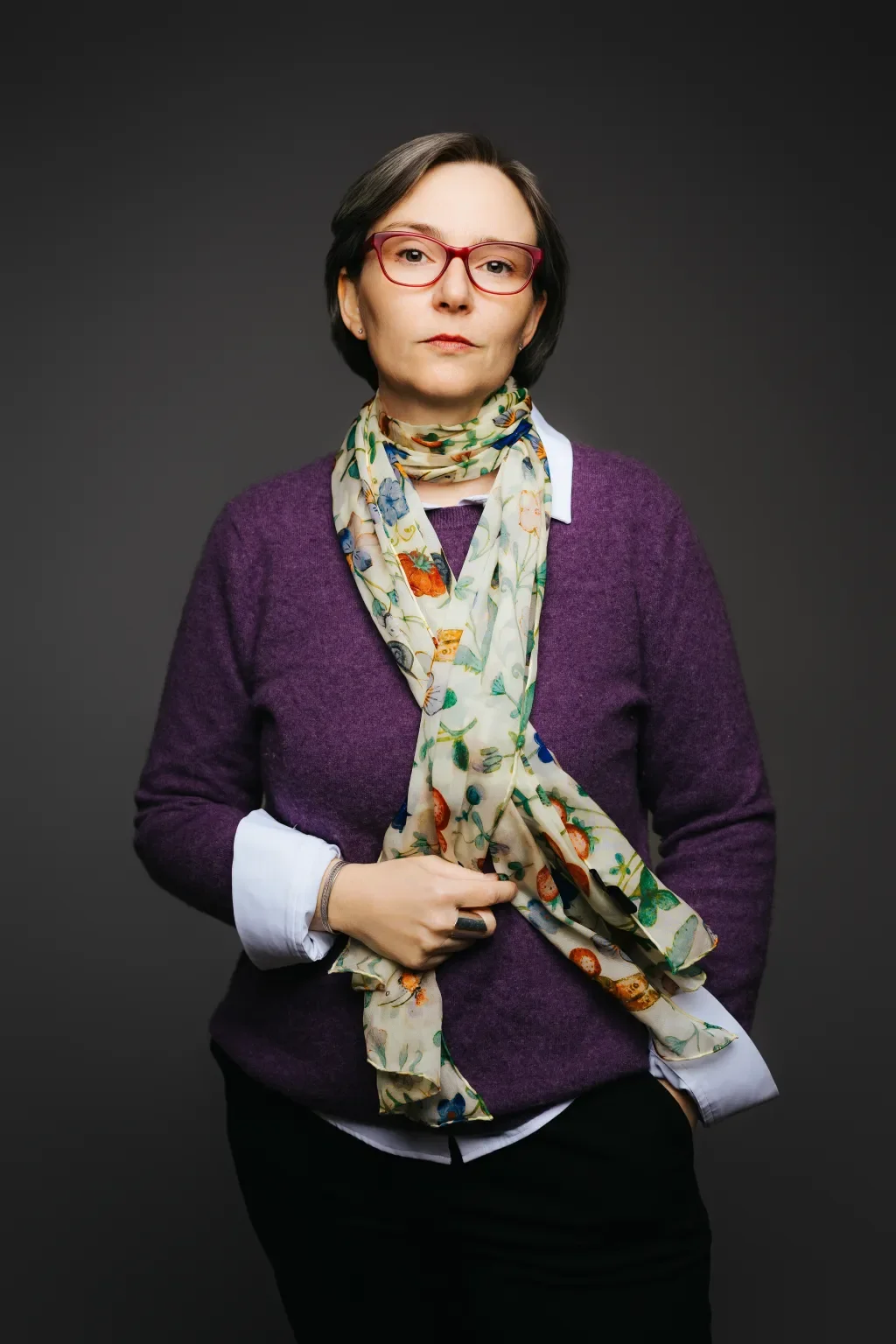
Adrianne Mathiowetz Photography
Leah De Forest was born in Geelong, Australia, and lives in Boston. Her debut novel, Any Kind of Known Tomorrow, is out 9/15/26 from Betty, an imprint of WTAW Press. Her short stories and essays have appeared in Griffith Review, CRAFT Literary, Ohio University’s Quarter After Eight, Fiction Writers Review and Kill Your Darlings, among other venues. She serves as a senior editor at Bloom, a literary website featuring authors who debut at 40 or older, and publishes The Point of View Playbook, a craft resource for writers.
Leah teaches writing at the Harvard Extension and Summer Schools (where she is also an academic advisor in the graduate writing program), was a contributor in fiction at the 2022 Bread Loaf Writers’ Conference, and holds an MFA from the Program For Writers at Warren Wilson College. A former ward of the State, Leah has worked as a journalist, book reviewer, columnist, speech writer, and public servant.